Hey there, if you’re running a business that uses distribution cabinets—let’s say factories, warehouses, even big retail spaces—you’ve probably noticed that your electricity bill has been creeping up lately. And if you haven’t checked your power factor numbers yet, that’s probably why. Power factor correction (PFC) devices are the unsung heroes here, cutting those unnecessary costs, boosting your cabinet’s efficiency, and even keeping your gear from overheating. As a distribution cabinet supplier, I’ve installed these myself (or walked our clients through the process) a hundred times, and it’s way simpler than it sounds—no need for a fancy electrician unless you’re totally new to this stuff. Let’s break it down step by step, like we’re chatting over coffee. Distribution Cabinet

First things first—before you even touch a screwdriver, let’s get the basics right. What’s power factor, anyway? Think of electricity as two parts: the real stuff that actually does work (like running a motor or lighting a warehouse) and the reactive stuff that just hangs around, creating magnetic fields but doesn’t help. Power factor is the ratio of real power (kW) to apparent power (kVA) you draw from the grid. A good power factor is around 0.95 to 0.98—anything lower than 0.9 means you’re wasting money on reactive power, and utilities will actually charge you a penalty for that. That’s where a PFC device comes in: it cancels out that reactive power, so your distribution cabinet only draws the real power it needs. I’ve seen clients knock $1,000+ off their monthly bills just by fixing a shoddy power factor—worth the 2-hour install, right?
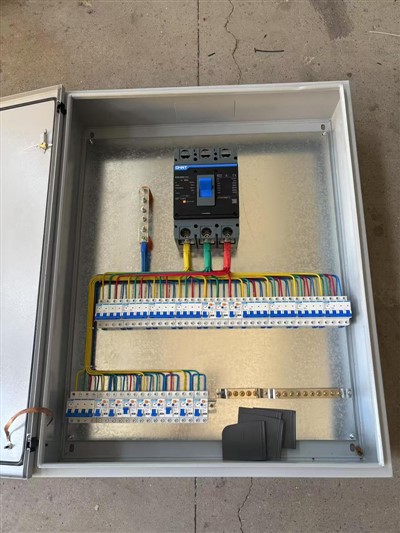
Now, prep work is key. I can’t tell you how many times I’ve showed up to a site where someone skipped this step and had to redo everything. First, turn off the main breaker to your distribution cabinet. Wait 10 full minutes before you start—those big capacitors in the cabinet hold a charge, and even with the power off, they can zap you. Trust me, I’ve had a small shock once when I was still new, and it’s not fun. Next, grab your tools: a multimeter (to test for dead power, non-negotiable), wire cutters/strippers, a screwdriver set, and your PFC device (make sure it’s rated for your cabinet’s voltage and current—we make these exact devices, so we always tell clients to match the specs of their cabinet, not guess). Also, jot down your cabinet’s make and model—if you bought yours from us, we’ve got a compatibility cheat sheet ready to go, no hunting around. One quick check: locate the main busbars inside your cabinet—those thick metal strips that distribute power. You’ll need space near them to mount the PFC, so clear out any extra cables or old parts first.
Next step: mount the PFC device. Most of our PFC units come with a metal bracket, so this is easy. Pick a spot near the busbars—close enough so the cables you run are short (longer cables mean more resistance, which defeats the purpose) but not too close that they overheat. If your cabinet has a vent, aim for that spot to keep the PFC cool—they don’t like high temps, that’s a common mistake. Secure the bracket with the screws provided, then snap the PFC unit into it (our units have quick-release tabs, so no fancy tools here). Once it’s mounted, double-check that it’s tight—wiggling it loose is a recipe for a bad connection.
Now the wiring part—this is where people usually get nervous, but stick with it. First, use your multimeter to confirm no power is present on the busbars. Set it to AC voltage, touch one probe to the busbar and the other to a ground point inside the cabinet (the metal frame, not a cable). If it reads 0V, you’re good. Now, you need to connect the PFC to two places: the main power supply (after the main breaker, before the load circuits) and the ground. Our PFC devices have three terminals: L (line, power in), N (neutral), and G (ground). Strip about ½ inch of insulation off each wire end. Connect the L wire to a spare terminal on the busbar (we label spare terminals on all our cabinets for this exact reason—no cutting into main power lines). Connect the N wire to the neutral busbar, same thing. Then the ground wire to the cabinet’s ground terminal—this is super important for safety, don’t skip it. Wait, if your cabinet is a 3-phase unit? No problem, our PFCs work with single or 3-phase, just match the phase terminals correctly (we print a little sticker on the PFC unit showing which is which). Once all wires are connected, tighten the terminal screws firmly, then tuck any extra cables away so they don’t block ventilation or get pinched by the cabinet door.
Now, the final checks before turning the power back on. Let’s not skip these—this is how you avoid blowing a fuse or frying your new PFC. First, close the cabinet door and lock it (so no one accidentally turns on power while you’re testing). Turn the main breaker back on slowly, don’t just flip it all the way. Wait 5 minutes, then grab your multimeter again. Test the voltage at the PFC’s terminals—it should match your cabinet’s rated voltage (like 240V or 480V). Next, grab a power factor meter (you can buy a cheap one online, or if you bought your cabinet from us, we even lend them to regular clients) and clip it onto the main power cable going out of the cabinet. Write that number down—this is your pre-PFC power factor.
Now, test the PFC itself. Most modern PFCs have a little LED light—green means it’s working, red means there’s a problem. If it’s red, immediately turn the power back off. The most common issues here are a bad ground connection, a wire that’s too loose, or a PFC unit that’s not compatible with your cabinet. If the LED is green, fire up some of your biggest equipment—like your factory’s conveyor belt, or a warehouse’s HVAC units. Wait 10 minutes, then check that power factor meter again. If you did everything right, it should jump up to 0.9 or higher. That’s the sweet spot. If it’s lower, maybe you need a slightly bigger PFC unit—we can help you size that for free, no hard sell.
Wait a quick pro tip from experience: don’t overdo it with the PFC. If you install a unit that’s too powerful for your cabinet, you’ll get a leading power factor, which is just as bad as a low one—your utility might penalize you for that too. That’s why we always ask clients to send us their cabinet’s current draw numbers before suggesting a PFC, it takes 2 minutes and saves you a headache. Also, check the connections every 6 months—vibration from motors can loosen wires over time, and a bad connection can make your PFC stop working.
I know some of you might be thinking “what if I mess this up?” and that’s totally fair. If you’re not comfortable working with electricity, hire a licensed electrician—most can do this in an hour, and it’s way cheaper than fixing a burnt-up cabinet. But if you’re handy with tools, have that multimeter, and take it slow, you can totally do it yourself.
Look, as a distribution cabinet supplier, our job isn’t just to sell you a cabinet—it’s to make sure it works as efficiently as possible for you. That means walking you through every part of installing add-ons like PFC, answering questions at 7 PM when you’re testing a new setup, and replacing parts if something goes wrong. We’ve installed hundreds of these across all kinds of cabinets, so we know the ins and outs.
If you’ve tried installing a PFC before and it didn’t work, or you just want to upgrade your current cabinet to cut those power bills, reach out to us for a no-obligation chat. We can walk you through sizing the right PFC, send you a step-by-step guide specific to your cabinet model, or even send a local tech to help if you’re in a pinch. No pressure, just honest advice.
Now, quick recap to make sure you didn’t miss anything: turn off power first, double-check it’s off, mount the PFC near the busbars, wire L/N/G correctly, test before loading, and don’t oversize the unit. That’s it. Your wallet will thank you in the next utility bill.
Tertiary Distribution Box References:
- Electrical Construction Maintenance: Power Factor Correction for Industrial Applications, 2022
- National Electrical Code (NEC) Article 702: Power Factor Correction, 2023 Edition
- Distribution Cabinet Design and Efficiency Standards, International Electrical Testing Association (NETA), 2021
Anhui Nanxian Electric Co., Ltd.
With abundant experience, we are one of the most professional distribution cabinet manufacturers and suppliers in China. We warmly welcome you to buy advanced distribution cabinet for sale here and get quotation from our factory. All customized products are with high quality and low price.
Address: Factory Unit 03-2, Building 21, Feidong Yinfeng Industrial Park Co., Ltd., Northeast Corner of Manquan Road and Changle Road, Hefei Circular Economy Demonstration Park, Feidong County, Hefei City, Anhui Province.
E-mail: 541580567@qq.com
WebSite: https://www.nxelepower.com/
