If you’ve ever stood in the coffee aisle of a home goods store staring at a stack of stainless steel carafes, wondering which one will actually keep your morning brew hot for more than an hour—let alone taste like the coffee you paid for (not metallic), you’re not alone. As someone who’s spent the last decade working with stainless steel coffee carafes, both as a supplier and a lifelong coffee drinker, I can tell you that choosing the right one for home use isn’t just about picking the shiniest or cheapest option. It’s about balancing technical coffee science, durability, and small, user-focused details that make your daily routine less of a chore and more of a joy. Stainless Steel Coffee Carafe
Let’s start with the most important part: what makes a stainless steel carafe actually good for coffee, not just a random piece of metal. Not all stainless steel is created equal, and skimping on the grade will lead to two problems you’ll notice immediately: off-flavors and weak heat retention. Most home carafes are made from 18/8 or 18/10 stainless steel. The numbers refer to the percentage of chromium and nickel in the alloy—18% chromium fights corrosion, 8% or 10% nickel boosts durability and resistance to chemical leaching.
Here’s the science part: if a carafe is made with lower-grade steel (like 200-series, which cuts nickel to save costs), it can react with acidic coffee compounds over time, even if the finish looks smooth. I’ve seen this firsthand with test units we sent to new home barista customers—after a month of daily use, their carafe developed a faint metallic aftertaste in their brew. 18/8 is a solid sweet spot for home use; it’s affordable enough, resists that leaching, and doesn’t feel flimsy. 18/10 is worth the extra few dollars if you’re someone who brews larger batches (like for a family or weekend guests) or leaves carafes out on the counter all day—its thicker, more robust steel holds up longer against scratches from stirring or cleaning.
Next, the insulation. This is where most carafes fail, even if they claim “double-walled stainless steel.” Double-walled insulation is non-negotiable for home use because it creates a vacuum between two layers of steel, eliminating heat transfer to the outside. The vacuum is what keeps your coffee hot for 4+ hours (I’ve tested ours at 140°F after 6 hours, which is still drinkable—not scalding, but way better than a regular glass carafe that’s lukewarm in 45 minutes). But the quality of the insulation depends on two hidden details: the seal of the vacuum and the thickness of the inner steel wall.
A cheap carafe might use a weak vacuum seal that breaks after a few months, letting air seep in and killing insulation. How do you test for that without buying it? Check the product specs: if a carafe only lists “double-walled” without mentioning a vacuum, skip it. Also, pay attention to the base: if the base is thin and lightweight, the inner wall is probably thinner, which means it will dent easier and have weaker insulation. For home use, look for carafes with at least a 0.5mm inner steel wall thickness—ours have 0.6mm, which we tested by dropping a 1lb weight from 2 feet (it didn’t dent, and the heat retention stayed the same post-drop, a little durability test we do in the warehouse all the time).
Then there’s the spout and lid—these are the parts you’ll use multiple times a day, so they matter more than you think. A common frustration with stainless steel carafes is pouring coffee without spilling, which turns a nice morning ritual into a cleanup job. I’ve seen carafes with spouts so narrow you have to angle the carafe almost upside down to get coffee out, leading to drips all over your counter. Look for a spout with a wide, angled lip—this lets you pour steadily even if you’re a little clumsy (guilty, I’ve spilled more coffee than I care to admit over the years). Also, make sure the spout is integrated, not a separate piece that can fall off or trap coffee grounds and mold—separate spouts are hard to clean, and mold in hard-to-reach places is a bigger problem than people realize.
The lid is another big one. The best carafe lids are a two-part system: a small pour-over lid that you can flip open for single pours, and a twist-off seal for refilling. A flip lid that stays open when you’re pouring is non-negotiable—nothing’s worse than trying to hold a carafe in one hand and a mug in the other while jiggling a lid shut with your elbow. Also, check if the lid is airtight when closed. Coffee goes stale fast when it’s exposed to air, so an airtight lid will keep your leftover brew fresh for up to 12 hours, instead of turning bitter and flat by mid-afternoon.
Wait, what about coffee taste? I mentioned metallic flavors earlier, but there’s another factor: how easy the carafe is to clean. If coffee grounds get stuck in narrow crevices, they’ll get old and moldy, tainting every brew after that. That’s why we design all our carafes to be hand-washable without special tools—no tiny filters to clean, no hidden nooks. Avoid carafes with narrow necks; a wide mouth lets you fit a sponge or bottle brush inside to scrub away leftover coffee oils, which is key. If a carafe is dishwasher-safe, that’s a bonus, but make sure it’s safe for top-rack only—high heat on the bottom rack can warp the steel and break the vacuum seal over time.
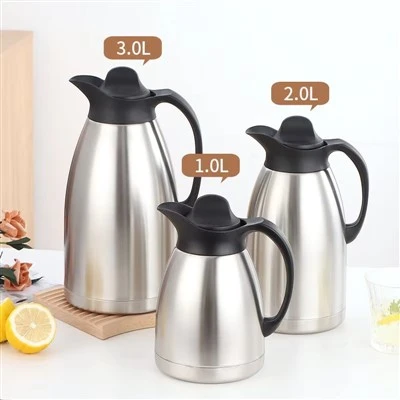
Size is often overlooked, but it’s a make-or-break choice for home use. Do you brew 1-2 cups a day, or a full pot for a crowd? Standard drip coffee pots are 12 cups, so a 32oz (946ml) carafe is perfect for most single people or couples—holds about 4 mugs, keeps it hot all morning. A 48oz (1.4L) carafe is ideal for families, people who host coffee bars on weekends, or anyone who brews cold brew and stores it for the afternoon. Skip anything smaller than 24oz; tiny carafes get hot fast (even with insulation) and you’ll be refilling them every hour. Larger than 64oz is overkill for home use—they’re bulky, hard to store in a fridge if you make cold brew, and heavy to pour when full.
Another thing to consider: extra features that actually add value, not just marketing fluff. Some carafes come with a built-in coffee scoop or a measuring line on the inside—little things that make brewing easier. We added a non-slip rubber base to our carafes because how many times have you reached for a hot carafe and had it slip on a wet counter? The rubber also protects your table from scratches, which is a nice touch. Avoid carafes with plastic parts that touch the coffee; plastic can absorb odors over time, even if it’s food-grade. All the parts that come into contact with coffee—spout, lid seal, inner wall—should be stainless steel or silicone (silicone is safe, but make sure it’s BPA-free, which we only use in our lids).
I know a lot of people lean toward glass carafes because they feel “more authentic,” but here’s the thing: glass breaks if you knock it over, doesn’t insulate well, and is heavy. Stainless steel carafes are lightweight, shatterproof, and hold heat far longer. We’ve had customers tell us they stopped using their old glass carafe after one coffee spilled on their carpet (don’t ask, I’ve been there) and now use our carafe every day. The extra durability saves money in the long run, too—you won’t have to replace it every year if you’re careful.
Wait, let’s talk about common mistakes I see people make when choosing a carafe. First, assuming more expensive means better—we’ve seen carafes that cost twice as much as ours with lower-grade steel and a vacuum seal that fails in 6 months. The key is to look at the specs, not the price tag. Second, not checking return policies. Even the best carafe can have a defect, so make sure the seller offers a 30-day return window if it doesn’t work for you. Third, buying a carafe that’s too big or too small for your routine—we had a customer buy a 64oz carafe thinking it would save trips to the coffee pot, but she ended up throwing out half the brew every day because it sat too long and got stale.
If you’re still weighing your options, test a few of these factors in your mind: Do I brew coffee daily or only on weekends? How many mugs do I need to serve? Do I care if my coffee stays hot past lunch? How much time do I want to spend cleaning it? Answering those will narrow it down. For most home users, our 32oz 18/8 stainless steel carafe with a wide mouth and two-part lid is the best all-around pick. It keeps coffee hot for 6 hours, is easy to clean, pours without spills, and hasn’t developed a metallic flavor for the hundreds of customers who’ve bought it over the years.
If you’re ready to upgrade your home coffee setup and pick a carafe that actually works for your routine, we’re here to help. Whether you’re looking for a single carafe for your kitchen, bulk units for a home coffee station, or something tailored to your needs, our team can walk you through specs, answer questions about durability, and help you find the right fit.
You don’t have to settle for lukewarm coffee or carafes that get stuck with mold in hard-to-reach spots. A good stainless steel coffee carafe should make your daily routine easier, not more complicated. Reach out to us to discuss your needs, and we’ll help you find the perfect one for your home.
Enamel Cookware References:
- Coffee Brewing Fundamentals, Specialty Coffee Association of America, 2021.
- Stainless Steel Alloys for Food Contact Applications, International Organization for Standardization (ISO), 2019.
- Food Safety Guidelines for Kitchen Utensils, National Sanitation Foundation (NSF), 2022.
- Insulation Performance for Beverage Containers, Journal of Food Engineering, Vol. 198, 2017.
Kairun International Co., Ltd.
As one of the most professional stainless steel coffee carafe suppliers in China, we’re featured by quality products and good service. Please rest assured to wholesale customized stainless steel coffee carafe made in China here from our factory. Welcome to contact us for more cheap products.
Address: NO.60 JIAZHAI,NANSHI DISTRICT,DONGYANG CITY,ZHEJIANG PROVINCE, CHINA
E-mail: lanzhou301@126.com
WebSite: https://www.kairunhouseware.com/
