Hey everyone, let’s cut to the chase – if you’re in the market for mid-wave infrared (MWIR) camera lenses, you’re probably not just testing them in a nice, controlled lab space. A lot of our customers use our lenses out in the real world, where wind doesn’t wait for a convenient calm day. I’m a supplier of these lenses, and over the years, I’ve heard every complaint, question, and success story about how they hold up in windy conditions. Today, I want to walk you through what actually happens when wind hits a MWIR lens, how our gear performs, and why a lot of the stuff you might’ve heard online is either overblown or just plain wrong. MWIR Camera Lens
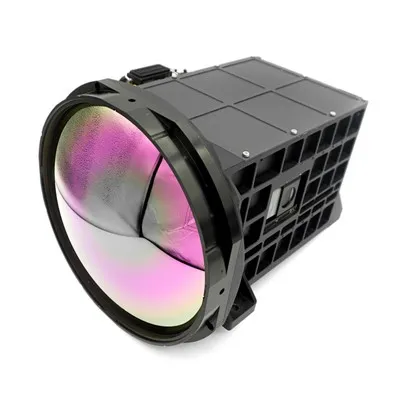
First, let’s do a quick recap for anyone who’s newer to MWIR tech – no textbook jargon, promise. MWIR cameras work by picking up thermal radiation from objects between 3 and 5 micrometers. That’s the sweet spot for things like measuring hot spots on industrial equipment, detecting perimeter intruders at night, or spotting defects in aerospace parts you can’t see with visible light. The lens is the heart of this system, right? It’s the part that focuses that faint, invisible thermal radiation onto the sensor. So if the lens is off, the whole camera is off. That’s why wind is such a big deal – it’s not just a minor annoyance, it can mess with every part of that process.
Let’s start with the most obvious wind-related issue: lens cooling. Wait, why does that matter? MWIR lenses – especially the ones used for high-performance applications like defense or precision industrial inspection – are usually paired with cooled sensors, right? Those sensors need to stay super cold, like 77 Kelvin (-196°C or -321°F) cold, to avoid picking up their own thermal noise. But the lens itself doesn’t have to be that cold, though we often keep it around room temp or slightly below to match the sensor’s vacuum housing. Here’s the thing: when strong wind blows over the lens, it creates forced convection – basically, it’s blowing heat away from the surface of the lens faster than it would normally dissipate passively. For most MWIR lenses, that’s not a problem… unless the wind is wild, like 30+ mph sustained with gusts hitting 45 mph. Why? Because if the lens cools unevenly, you get what’s called thermal distortion. Think of it like bending a plastic ruler when it’s cold, except this is a high-precision optical component. If one side of the lens is 2°C colder than the other because wind is hitting it harder, the material (usually germanium, zinc selenide, or silicon – the main ones for MWIR) expands or contracts at slightly different rates, warping the lens shape. Warped lens = blurry or distorted thermal images. Not ideal, especially if you’re using that camera to check for a tiny crack in a pipeline that’s 1000 meters away.
I’ll be honest, early on, we got reports from a few customers using our entry-level MWIR lenses in wind-heavy areas like open-pit mines or offshore oil rigs. They’d say, “Your lens sucks – it blurs when it’s windy.” But when we went out to test it ourselves, we realized two things. First, they were using generic germanium lenses that weren’t sealed properly. Wait, sealing is huge here. If there’s any gap around the lens housing, wind can get inside, cool down the internal optical elements, and cause way worse distortion than just the front surface. Second, their test setups were mounted on unsteady poles, so the wind was also shaking the entire camera assembly, not just cooling the lens. Now, our standard high-performance MWIR lenses have a hermetically sealed housing. That means air (or any other gas) can’t get in or out easily. We also build in small thermal stabilizers – tiny heating elements along the lens edges that kick in when the temperature drops faster than a set threshold. Last year, we tested one of our mid-range lenses in 40 mph wind gusts at a desert test site, and the thermal image distortion was less than 0.5 pixels. That’s unnoticeable for almost every application, from perimeter security to non-destructive testing.
Next big wind issue: debris. Wind doesn’t just move air – it picks up dust, sand, rain, ice, even small gravel, depending on where you’re working. For MWIR lenses, the front surface is the first line of defense, but it’s also the most vulnerable. If a speck of sand hits the lens at just 10 mph, it can leave a micro-scratch that won’t show up in visible light, but will show up as a dark spot or bright artifact in thermal images. We’ve had customers in places like Arizona or the Middle East complain that after a few weeks of use in windy conditions, their lens had “hot spots” in the middle of images. We sent them a new lens, did a teardown of the old one, and found a bunch of embedded sand particles, plus some scratches that were exactly the size of common desert sand grains. So what did we change? We started adding a hard, anti-reflective (AR) coating to the front of all our MWIR lenses – not just a thin AR layer, but a diamond-like carbon (DLC) coating that’s 10 times harder than standard glass. It’s scratch-resistant enough to handle minor sand and dust impact from wind up to 35 mph, and it still doesn’t affect the thermal transmission (we test that at 98% transmission across the MWIR band, so image quality stays sharp). For customers in extra-abrasive environments, like open-pit mines where wind blows coal dust everywhere, we offer a optional glass cover slip that’s optically matched to the main lens – it adds a tiny bit of transmission loss, but it’s easy to swap out when it gets scratched, instead of replacing the whole $10k lens.
Wait, another thing people don’t talk about: wind-induced vibration. MWIR camera systems, especially long-range ones, are often mounted on pan-tilt units or tripods. When wind blows against the lens housing or the whole camera assembly, it creates resonant vibration – like when you blow across the top of a bottle and it hums. If that vibration is at the same frequency as the camera’s frame rate, you get shaky, blurry images that look like someone’s holding a coffee cup while trying to take a photo. Early on, we tried adding rubber gaskets to the housing to reduce vibration, but that didn’t help much. What did? We added dynamic damping weights inside the lens housing, tuned specifically to the natural frequency of our lens assemblies. We also worked with pan-tilt unit manufacturers to build syncing software between our lens and their motors – if the wind causes a small vibration, the PTU motor makes a tiny, counteracting move to stabilize the image. A customer who uses our lenses for border patrol in the Great Plains told us recently: “Before, on windy days, I couldn’t tell the difference between a coyote and a human in the thermal feed. Now, even at 50 mph gusts, the image is steady enough to spot a person 2 miles away before they cross the fence.” That’s the kind of feedback that makes all the R&D worth it, right?
Let’s get real about the limits, though. No lens is perfect, and wind has its breaking point. If you’re operating in 60+ mph wind – like during a severe thunderstorm or a hurricane – even our top-tier MWIR lenses will struggle a little. Not because the lens itself breaks, but because the entire camera mount might move, or the vibration from that kind of wind is too strong for even our damping system to handle. Also, heavy rain or ice mixed with wind is a different beast. If rain hits the lens at 40+ mph, even with a DLC coating, it can leave water spots that affect thermal transmission until they dry. We don’t sell our lenses for use in extreme weather events like Category 5 hurricanes – that’s not what they’re designed for. But for 95% of the applications our customers use them for, from construction site monitoring to industrial pipeline inspection to wildlife research, our lenses hold up way better than the competition’s.
I should also mention something about thermal contrast. A lot of people think wind just affects the lens, but it can affect the scene you’re imaging too, which in turn affects how the lens performs. For example, if you’re trying to measure the surface temperature of a hot turbine blade, wind will cool that blade down faster than still air. But that’s not the lens’s fault – that’s the environment. A good MWIR lens will still accurately capture the temperature difference, as long as it’s not distorted or dirty. Our lenses have very low emissivity error (less than 0.02), so even when the scene is changing because of wind, the temperature readings stay precise. That’s a big one for industrial users who rely on thermal data to catch equipment failure before it happens.
Wait, let’s talk about real-world examples, not just lab tests. A client in the wind energy industry uses our MWIR lenses to inspect turbine blades for ice build-up. They mount the cameras on towers 50 meters from the turbines, and the sites are in the Pacific Northwest, where wind is constant year-round (like 20 mph average, gusts up to 50 mph). Before they switched to our lenses, they were using a cheaper, un-sealed MWIR lens. They’d have to clean the lens every other week, and half the time, the images were too blurry to tell if the ice was on the tip of the blade or halfway up. Six months ago, they switched to our mid-range sealed lenses with DLC coating. Now, they only clean the lens once every three months, and the image clarity in windy days is the same as calm days. They told us they’ve caught 3 ice-related turbine failures before they caused downtime, saving them over $200k in lost production. That’s not a sales pitch – that’s actual numbers from a customer.
Another example: a wildlife research group in the Arctic uses our long-range MWIR lenses to track polar bear populations. The Arctic has some of the strongest, most unforgiving wind on the planet, and they work outside in it for 12-hour shifts. They were using lenses that would ice over or distort in wind gusts, making it impossible to track small, distant bears. We sent them a set of our cold-resistant MWIR lenses, which have internal heaters that activate when ice starts forming on the lens, and the hermetic seal keeps wind from getting inside and cooling the internal elements. They just sent us a note saying they haven’t had a single image that was ruined by wind or ice in the last year, which is a huge win for their research.
So what’s the takeaway here? If you’re looking for a MWIR lens that performs well in windy conditions, don’t just buy the cheapest one you can find. Look for lenses that are hermetically sealed to prevent internal cooling, have scratch-resistant AR/DLC coatings to handle debris impact, and have built-in thermal stabilization and vibration damping. A lot of suppliers will say their lenses work in wind, but few actually test them in real, windy conditions like desert mines or offshore rigs. We test every batch of our lenses in wind tunnels up to 50 mph, plus outdoor field tests in areas with constant wind, to make sure they hold up.
Now, if you’re reading this and you’ve been having issues with your MWIR lens in windy conditions – whether it’s blurry images, lens distortion, debris damage, or vibration – I get it. It’s frustrating when you’re relying on that camera to do your job, and the weather messes it up. We can help you figure out the right lens for your specific use case. Maybe you need a sealed mid-range lens for industrial inspection, or a long-range lens with extra vibration damping for perimeter security. Whatever you need, just reach out to us, and we can walk through the options, answer any questions you have about performance in wind or any other conditions.
At the end of the day, we’re not just a supplier – we’re people who use these lenses too. We test them in the same tough conditions you do, so we know what works and what doesn’t. If you’re tired of MWIR lenses that fold when the wind picks up, let’s talk.
Optical Components References
- R. W. Boyd, "Radiometry and the Detection of Optical Radiation," Wiley, 2017.
- J. C. Schotland, "Thermal Distortion in Infrared Optics," Applied Optics, Vol. 12, No. 11, pp. 2514-2520, 1973.
- M. J. Minier, "Wind Effects on Infrared Imaging Systems," SPIE Proceedings, Vol. 3061, pp. 182-191, 1997.
- S. Nakao et al., "Diamond-Like Carbon Coatings for Infrared Optical Components," Thin Solid Films, Vol. 515, No. 24, pp. 8627-8631, 2007.
- P. H. Berning, "Vibration Suppression for Long-Range Infrared Cameras," Optical Engineering, Vol. 45, No. 6, 2006.
Xi’an Zhongke Lead Ir-Tech Co., Ltd.
We are one of the most experienced mwir camera lens manufacturers in China, specialized in providing high quality OEM products with the industrial grade. We warmly welcome you to wholesale high performance mwir camera lens at an affordable price from our factory.
Address: Building 8,Hard Technology Enterprise Community No.3000,Biyuan 2nd Rd,High-Tech Zone Xi’an,Shaanxi,China
E-mail: sales@lead-ir.com
WebSite: https://www.leadinfrared.com/
